
Radical Hospitality
Why God’s Table Always Has Room for One More
Drew Borowsky, Regional Promotions Coordinator
I built my kitchen table out of a door I pulled off an abandoned house in Detroit. I asked the guys on the corner if I could have it. I stained it, pressed plumber’s pipe in all the right places underneath, and it’s been standing strong for over a decade. The funny thing about that table? It always seems to have room for exactly the right number of people. It always seems to have room for one more.
I’ve come to believe that table is a picture of something that sits at the very center of the Christian life.
One Job
In 2 Corinthians 5:18–20, Paul wrote “And All this is from God, who reconciled us to himself through Christ and gave us the ministry of reconciliation: 19 that God was reconciling the world to himself in Christ, not counting people’s sins against them. And he has committed to us the message of reconciliation. 20 We are therefore Christ’s ambassadors, as though God were making his appeal through us. We implore you on Christ’s behalf: Be reconciled to God” (NIV).
The Greek word behind ministry here is ordinary. It basically just means job. And this is the only time it appears in all of scripture. One ministry. One job. Reconciliation: drawing people back to God, by not holding their sins against them and by making His appeal available through us.
The ancient table
Long before Jesus told stories about banquets, the table carried a specific kind of weight in the ancient world. The Hebrew word is solha—a reconciliation meal. When two parties reach an impasse they cannot resolve on their own, they sit down together, lay everything open, and acknowledge their shared brokenness. It was agreed—we’re not leaving here until this is worked out. And it happens over a meal.
There’s always room for one more; that’s how it works in the Kingdom.
That motif runs all through the Old Testament. Psalm 23 is one of the most beloved passages in scripture, but I wonder if we often read right past the startling verse right in the middle of it. David writes: “You prepare a table before me in the presence of my enemies; my cup overflows” (Psalm 23:5 NIV).
David had real enemies, people with swords and grievances. So, what exactly is he thanking God for? He’s thanking Him for the chance to sit with them. Because he understood enemies stopped being enemies around the table.
Kingdom math
In Luke 14, Jesus is at a meal with Pharisees, practically making it His job to go from table to table, while He tells a story. Let me paraphrase. A man throws a great banquet. His invited guests bail with excuses. So the host sends servants into the streets to bring in the poor, the crippled, the blind, and the lame—exactly the people the Pharisees believed would never be at God’s table. The servants report back: it’s done, but there is still room. Go further, the master says. The roads, the country lanes. Fill this house. (See Luke 14:21–23).

And there’s still room.
That’s kingdom math. There’s always room for one more. The Creator God, who owns everything and knows every name—yours, theirs, and the name of every person you’ve quietly written off—His table does not run out.
The tunnel, the rain, and Ray
In 2014, during one of the harder summers of my life, I laced up my rollerblades one night and went somewhere I’d never gone before. I rolled miles from home and ended up inside a graffiti-covered tunnel in downtown Utica, Michigan. I found six people in a circle, singing and praying with a guitar. It was exactly what I needed for a season when I hadn’t been able to get there myself.
We started meeting regularly in that tunnel, and we’d pray the same prayer before every gathering: God, send whoever needs to be here. He was faithful to do it.
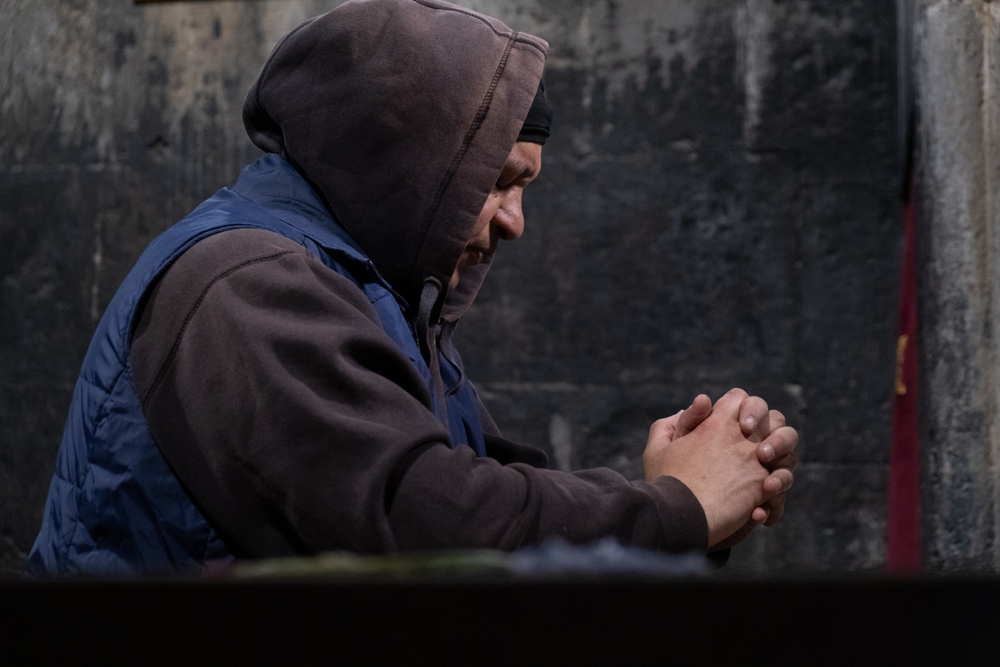
One night, a man named Ray came through—hood up, beer in hand. He sat in the corner just like I had. We blessed him. He wept. He told us he’d heard the music from his porch a block away. He’d lost his kids in a divorce. He was low, and he’d been praying for a guardian angel. He poured out his beer and walked out.

Then he came back with chips and pop. “I know it’s not much,” he said, “but it’s all I have.”
He set the table for us. And I’ve sat with that for a long time—because the man who needed the table ended up being the one who fed us. I’ve come to believe that’s not a footnote to the story. It’s actually the point.
The table goes both ways.
I’m preaching to myself here, and I need to confess something. Maybe you can relate. I love events. I love ministry. I love being the one who shows up and sets the table for others. But when I get home, sometimes I’m tired. Frustrated. I can be annoyed. I have a two-year-old who keeps us up and is absolutely wild—he’s the best, but he is absolutely wild—and I can just be spent. Do you know that feeling?
So there I am, and I look out the window and see my neighbor Betty White (That’s really her name.)—a 75-year-old woman from our church, mowing our lawn and trimming our bushes. Then a Jewish couple a few doors down, Sarah and Carly, show up with bread they baked and an invitation to dinner. A neighbor brings a toy for our son, Liam. And then I look out again and see the tattooed guy from across the street taking out our garbage. When he catches my eye, he waves and invites me to church.
All of this occurred within a single month.
I haven’t quite figured out everything God is trying to show me through all of that. But one thing I’m realizing is maybe God wants to use them to show us His love and His hospitality —and change our hearts toward the people in the world that He still loves.

Because the table goes both ways, it’s actually a bridge. And sometimes the most faithful thing we can do is sit down, open our hands, and let the neighborhood feed us.
A prayer to carry with you
Before your next event, gathering, or conversation with someone who needs the table, try praying this: God, send whoever needs to be here. It’s a dangerous prayer. He honors it.
And when you find yourself on the receiving end—tired, spent, watching someone unexpected show up for you—try this one: God, what are You trying to show me here?
Because He’s already prepared the table. He’s already sent the invitation. The questions are will we make room and will we recognize it when someone else makes room for us.
Keep Going
If you’re starting to see the table in your own neighborhood, we have a five-day YouVersion Bible plan just for you. No Ordinary Moments: Kingdom Work in Everyday Life will help you slow down and see what God is already doing in the people, spaces, and moments right in front of you. Each day includes a scripture focus, a short reflection, an action step, and a guided prayer. The Kingdom is closer than you think. Start here.